


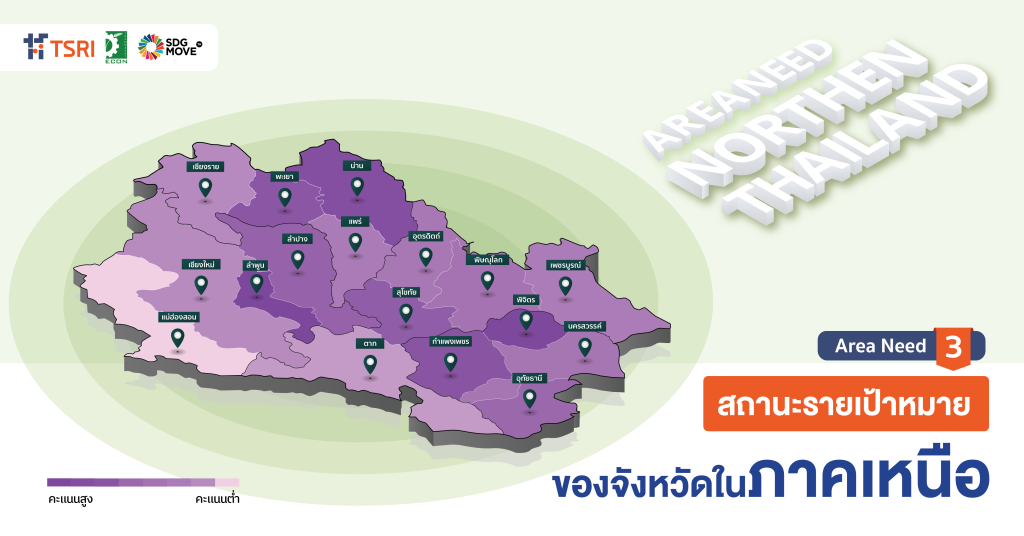
The Centre for SDG Research and Support (SDG Move), Faculty of Economics, Thammasat University, in collaboration with the Office of the National Higher Education Science Research and Innovation Policy Council (NXPO) and regional working groups from six regions—North, Northeast, Central, East, South, and Deep South—has released the Provincial SDG Index of Thailand.
This dataset results from research conducted under the project “Area Need: Integrated Planning of Science, Research, and Innovation for Sustainable Area-Based Development.” Its main objective is to serve as a foundational database for NXPO in planning and implementing research, science, and innovation (RSI) systems that support sustainable area-based development, without favouring any specific province.
Since 2021, SDG Move has worked jointly with academic networks across the country and NXPO to identify the challenges of sustainable development in each region according to the Sustainable Development Goals (SDGs). This reflects the integrated roles and cooperation between NXPO and Thammasat University in driving sustainable area-based development.
00 – Notes Before Reading the Report
A key process of Area Need 3 is the development of the Provincial Sustainable Development Goals Index (or Provincial SDG Index), an essential tool for measuring and monitoring progress in sustainable development within each area.
This process involves compiling and analysing national-level data relevant to the Sustainable Development Goals (SDGs), alongside identifying data gaps through workshops that present regional sustainable development challenges and gather input from local stakeholders. This work was conducted by the Centre for Research and Support for the Sustainable Development Goals (SDG Move), Faculty of Economics, Thammasat University.
The assessment of SDG progress at the provincial level is based on subnational secondary data to evaluate the status of SDGs for each province or city. Internationally, similar assessments using the SDG Index at city and state levels have been conducted since 2017 by networks under SDSN (Sustainable Development Solutions Network).
In Thailand, the Office of the National Economic and Social Development Council (NESDC) developed a set of provincial and regional development indicators in 2021 based on the 5Ps framework (People, Prosperity, Planet, Peace, and Partnership). Another notable study was undertaken by the United Nations Development Programme (UNDP) in collaboration with the Thailand Development Research Institute (TDRI) to produce the Provincial SDG Profile in 2023.
The Provincial SDG Index focuses primarily on indicators consistent with the global SDG Index. However, if other provincial indicators correspond to the SDG sub-targets—even if not part of the international index—they may also be included.
The key rationale is that improving Thailand’s position in the international SDG Index requires comprehensive data reflecting the real situation within the country. The integration of global and local indicators enables clearer identification of area-specific challenges, paving the way for problem-solving and the improvement of relevant indicators.
Methodology for Data Collection and Analysis
The process for developing the Provincial SDG Index consists of three main stages, as follows:
- Literature Review
This stage involved reviewing and compiling indicators from multiple sources, including the SDG Index, regional sustainability reports, SDG Profiles, and Thailand’s 2023 SDG Indicator Status Report. Appropriate indicators were then selected, proxy indicators defined, and a list of indicators for the project was prepared. Coordination was made with relevant agencies to compile a list of provincial-level indicators aligned with global SDG indicators. Each indicator was also documented with its responsible agency, data collection frequency, and reporting schedule. - Data Collection
In this stage, data were extracted or requested from relevant agencies at the provincial level, along with setting benchmark rules and target values. Data were sourced from various databases such as those of the National Statistical Office, as well as from other data-owning institutions. Priority was given to datasets covering at least five years; however, where data were available dating back to 2015 (B.E. 2558), such data were especially valuable for trend analysis. - Data Processing and Analysis
Data were compiled in a calculation template, normalised to a scale of 0–100, and averaged by SDG goal for both provincial and regional levels. Statistical methods were used to group indicator scores and define colour classifications based on target values, minimum thresholds, and distribution ranges.
01 – Overview of the Northern Region SDG Index
The average SDG Index score for the Northern Region stands at 50.57, reflecting an overall moderate level of sustainable development. Within the region, Lamphun Province achieved the highest score of 59.09, indicating notable progress towards achieving the Sustainable Development Goals (SDGs).
Meanwhile, Lampang, Nan, Phayao, Uthai Thani, Kamphaeng Phet, Sukhothai, and Phichit scored above the regional average, suggesting continued efforts toward sustainable development. Phitsanulok scored close to the regional average, reflecting a moderate level of progress in sustainability.
However, Chiang Mai, Uttaradit, Phrae, Chiang Rai, Nakhon Sawan, Tak, and Phetchabun scored below the regional average, indicating the need for accelerated development efforts. The province with the lowest SDG Index score, both in the region and nationally, is Mae Hong Son, with a score of 32.74, signifying significant challenges in achieving sustainable development.
Colour Legend for Status Indicators
- Green: Provinces with the strongest performance in each goal
- Yellow: Provinces performing above the national average
- Orange: Provinces showing room for improvement
- Red: Provinces requiring urgent action
- Grey: Data not available

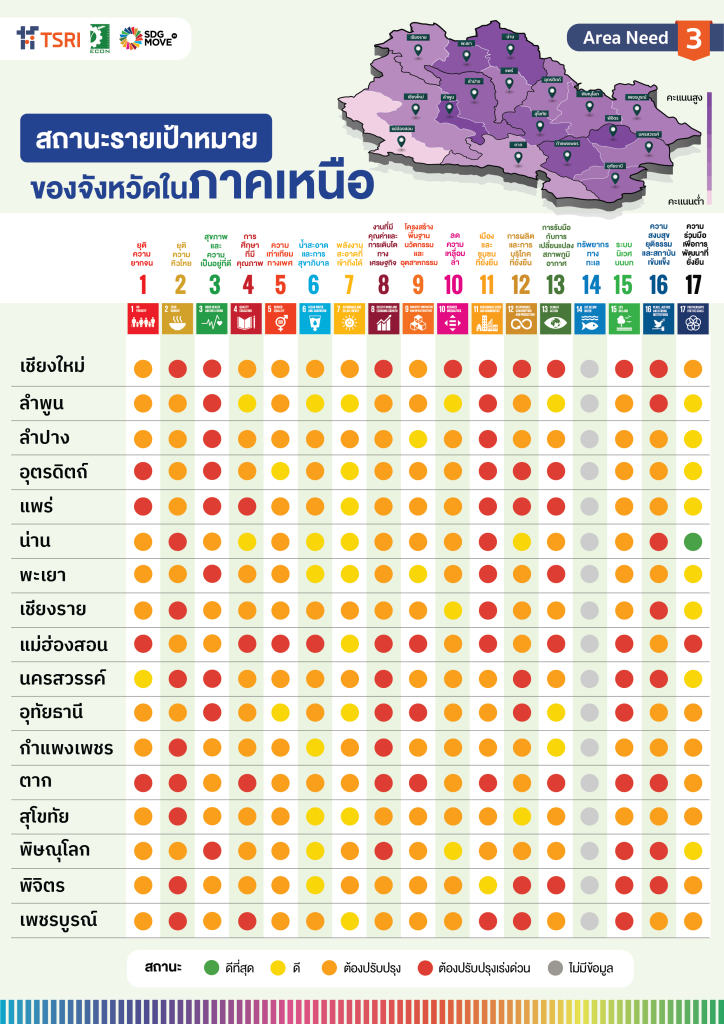
Provincial SDG Performance Status in the Northern Region
The SDG performance status of Northern provinces highlights several key findings:
- Overall, the region continues to face challenges in achieving the SDGs, particularly in social dimensions (SDG 1–5), economic dimensions (SDG 8–11), environmental dimensions (SDG 12, 13, 15), and peace and institutional dimensions (SDG 16). These findings indicate the need for urgent and systematic structural policy interventions.
- On the other hand, the region demonstrates relatively good performance in the partnership dimension (SDG 17), as well as in goals related to infrastructure development, particularly SDG 6 and SDG 7.
- Considerable variation exists among provinces in terms of progress across individual goals. Some provinces perform well in specific goals, while others require urgent improvement in comparison with regional peers.
When averaging indicator-level scores by goal across all Northern provinces,
the top five goals with the highest scores are:
| Rank | Goal | Score |
|---|---|---|
| 1 | SDG 6 – Clean Water and Sanitation | 72.57 |
| 2 | SDG 7 – Affordable and Clean Energy | 72.03 |
| 3 | SDG 16 – Peace, Justice and Strong Institutions | 68.54 |
| 4 | SDG 15 – Life on Land | 65.53 |
| 5 | SDG 13 – Climate Action | 57.10 |
It is evident that the goals with higher scores are mostly related to environmental and infrastructure issues.
Conversely, the five lowest-scoring goals are:
| Rank | Goal | Score |
|---|---|---|
| 1 | SDG 9 – Industry, Innovation and Infrastructure | 30.71 |
| 2 | SDG 11 – Sustainable Cities and Communities | 33.52 |
| 3 | SDG 4 – Quality Education | 35.41 |
| 4 | SDG 2 – Zero Hunger | 39.88 |
| 5 | SDG 17 – Partnerships for the Goals | 40.39 |
It can be observed that the lowest-scoring goals are predominantly related to social and economic challenges.
02 – Indicator-Level Findings for the Northern Region
A closer examination of the individual indicators reveals both areas of progress and ongoing challenges, as outlined below.
Indicators Showing Progress
- Agricultural land under sustainable farming practices (SDG 2)
- Neonatal mortality rate (≤ 28 days) (SDG 3)
- Municipal solid waste management and greenhouse gas emissions from industrial processes (SDG 12)
Indicators Showing Risk or Challenges
- Low-income or poor population (SDG 1)
- Nutritional status of children aged 0–5 years, prevalence of obesity, proportion of agricultural areas affected by natural disasters, and number of GAP-certified agricultural producers (SDG 2)
- Number of patients with air pollution-related illnesses (SDG 3)
- ONET test scores at Mathayom 3 and Mathayom 6 levels (SDG 4)
- Proportion of informal labour to total workforce (SDG 8)
- Percentage of households with internet access and number of research publications indexed in Scopus (SDG 9)
- PM2.5 concentration levels and development of public transport systems (SDG 11)
- Number of hotels certified under the Green Hotel Standard (SDG 12)
- Provincial tax revenue as a percentage of GDP (SDG 17)
The indicator-level analysis suggests that the Northern Region has made progress in certain dimensions of sustainable development, particularly in social and environmental aspects. However, the region continues to face major challenges in economic development, public health, and education issues that require urgent, coordinated, and area-specific interventions to promote equitable and sustainable progress across all provinces.
03 – Provinces with Notable Scores and Rankings
| Regional Rank | National Rank | Score | Province |
|---|---|---|---|
| 1 | 11 | 59.09 | Lamphun |
| 2 | 12 | 58.91 | Phichit |
| 3 | 22 | 57.43 | Nan |
| 4 | 31 | 56.29 | Kamphaeng Phet |
| 5 | 35 | 55.70 | Phayao |
| 6 | 47 | 54.10 | Sukhothai |
| 7 | 52 | 53.15 | Lampang |
| 8 | 55 | 52.18 | Uthai Thani |
| 9 | 66 | 50.16 | Phitsanulok |
| 10 | 68 | 49.58 | Nakhon Sawan |
| 11 | 69 | 49.10 | Uttaradit |
| 12 | 71 | 48.69 | Phrae |
| 13 | 72 | 48.44 | Phetchabun |
| 14 | 73 | 45.68 | Chiang Rai |
| 15 | 74 | 45.58 | Chiang Mai |
| 16 | 75 | 42.84 | Tak |
| 17 | 77 | 32.74 | Mae Hong Son |
Source: SDG Move and TSRI (2025)
Provinces with Notable Scores and Insights
An analysis of the SDG Index scores and rankings of the 17 provinces in Northern Thailand shows that the five highest-scoring provinces are:
1. Lamphun – 59.09 points
2. Phichit – 58.91 points
3. Nan – 57.43 points
4. Kamphaeng Phet – 56.29 points
5. Phayao – 55.70 points
When examined by individual indicators, Lamphun stands out for its consistently high performance across multiple SDG targets. The province performs relatively well (Yellow) in six goals, while seven goals are categorised as requiring improvement (Orange). However, three goals are identified as needing urgent improvement (Red), namely SDG 3(Good Health and Well-being), SDG 11 (Sustainable Cities and Communities), and SDG 16 (Peace, Justice, and Strong Institutions).
Conversely, the five lowest-scoring provinces in the North are:
17. Mae Hong Son – 32.74 points
16. Tak – 42.84 points
15. Chiang Mai – 45.58 points
14. Chiang Rai – 45.68 points
13. Phetchabun – 48.44 points
In the case of Mae Hong Son, which has the lowest score both regionally and nationally, analysis by indicators reveals that the province performs relatively well (Yellow) in only one goal – SDG 7 (Affordable and Clean Energy). Five goals are classified as requiring improvement (Orange), while as many as ten goals are in the urgent improvement (Red) category. These include SDG 1 (No Poverty), SDG 4 (Quality Education), SDG 5 (Gender Equality), SDG 6 (Clean Water and Sanitation), SDG 8 (Decent Work and Economic Growth), SDG 9 (Industry, Innovation and Infrastructure), SDG 11 (Sustainable Cities and Communities), SDG 13 (Climate Action), SDG 15 (Life on Land), and SDG 17(Partnerships for the Goals).
Overall, the findings highlight wide disparities in SDG Index performance across the northern region. Provinces such as Lamphun and Phichit demonstrate significant progress towards sustainable development, whereas provinces like Mae Hong Son, Tak, and Chiang Mai continue to face substantial challenges.
In the next article, SDG Move will present detailed analyses of provincial SDG Index results by region, with a focus on goal-specific progress and challenges. These insights aim to support local practitioners and stakeholders in translating findings into evidence-based policy and collaborative action.

